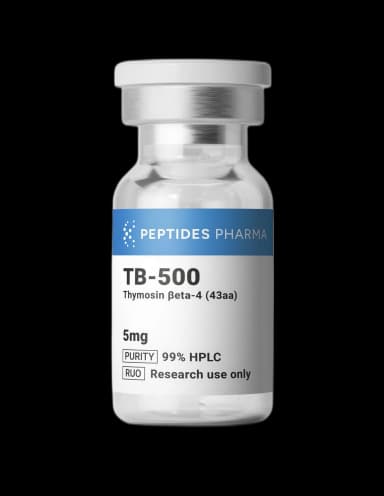
What is TB-500?
TB-500 (Thymosin Beta-4 Fragment) is classified as a thymic peptide / actin-binding protein fragment. With a molecular weight of 4963.44 Da and formula C212H350N56O78S, it is one of the most studied compounds in its class.
This encyclopedia entry covers the molecular profile, mechanism of action, research history, key published studies, and research applications of TB-500. It is part of the Peptides Pharma Peptide Encyclopedia, a scientific reference for researchers working with peptide compounds.
Molecular Profile
MOLECULAR FORMULA
C212H350N56O78S
MOLECULAR WEIGHT
4963.44 Da
CLASSIFICATION
Thymic Peptide / Actin-Binding Protein Fragment
AMINO ACID SEQUENCE / STRUCTURE
Fragment of Thymosin Beta-4 (43-amino acid peptide, LKKTET active domain)
Mechanism of Action
TB-500 is a synthetic version of the naturally occurring 43-amino acid peptide Thymosin Beta-4 (TB4), focusing on the active region responsible for actin binding and cell motility. Its primary mechanism involves binding to and sequestering monomeric actin (G-actin), which plays a central role in cellular migration, proliferation, and differentiation.
By modulating the actin cytoskeleton, TB-500 enables cells to move more efficiently to sites of injury. This enhanced cell migration is particularly relevant in wound healing, where keratinocytes, endothelial cells, and fibroblasts must travel to damaged tissue. TB-500 also promotes angiogenesis — new blood vessel formation — by upregulating VEGF and other angiogenic factors.
Beyond structural repair, TB-500 exhibits potent anti-inflammatory properties, reducing the production of pro-inflammatory cytokines while promoting the expression of anti-inflammatory mediators. Research also suggests it can reduce fibrosis (scar tissue formation) and promote functional tissue regeneration rather than mere scarring, which is critical for outcomes in cardiac, muscular, and dermal repair.
Research History
Thymosin Beta-4 was first isolated from the thymus gland in the 1960s by Allan Goldstein and colleagues. Initially studied for its role in immune regulation, researchers later discovered its profound effects on wound healing and tissue repair. The synthetic fragment TB-500 was developed to capture the most bioactive region of the full protein.
Research expanded significantly in the 2000s, with studies demonstrating TB-500's ability to promote cardiac repair following myocardial infarction, accelerate dermal wound healing, and reduce inflammation in various animal models. Its role in equine medicine, where it has been used extensively in racehorses for soft tissue repair, brought it to wider attention in the sports science community.
Key Published Studies
Thymosin beta-4 promotes cardiac cell migration, survival and cardiac repair
2004
Demonstrated TB4 activates cardiac progenitor cells and promotes heart tissue repair following myocardial infarction in mice.
Thymosin beta-4 accelerates wound healing in diabetic mice
2007
Showed significant acceleration of wound closure and re-epithelialisation in diabetic mouse models, a notoriously difficult healing context.
Anti-inflammatory effects of thymosin beta-4
2010
Established TB4's ability to downregulate NF-kB signalling and reduce pro-inflammatory cytokine production in multiple tissue models.
Thymosin beta-4 reduces fibrosis and promotes tissue regeneration
2012
Demonstrated reduced scar tissue formation and improved functional tissue recovery in cardiac and dermal injury models.
Research Applications
Wound healing and tissue repair studies
Cardiac regeneration research
Anti-inflammatory response research
Soft tissue injury recovery
Dermal healing and scarring reduction
Muscle repair and regeneration
Fibrosis reduction studies
RECOMMENDED PRODUCT