
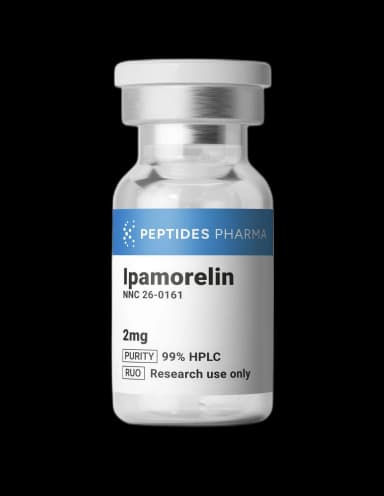
Ipamorelin: The Gold Standard for Selective GH Release
Ipamorelin is a synthetic pentapeptide growth hormone secretagogue that has earned its reputation as the most selective GHRP available. Its key characteristics:
Exceptional Selectivity: Studies consistently demonstrate that Ipamorelin stimulates GH release without significantly affecting cortisol, prolactin, ACTH, or aldosterone levels. This selectivity is unique among GH secretagogues and makes Ipamorelin invaluable for research requiring isolated GH effects.
Sustained Efficacy: Unlike Hexarelin, Ipamorelin shows minimal receptor desensitisation with chronic dosing. Research indicates it maintains consistent GH-releasing efficacy over extended protocols of 12 weeks or more.
Dose-Dependent Response: Ipamorelin produces a dose-dependent GH release that plateaus at higher doses without the ceiling effect seen with some other secretagogues. This allows for predictable dose-response relationships in research protocols.
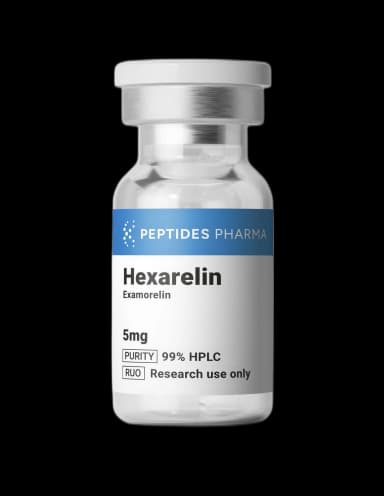
Hexarelin: Maximum GH Output with Broader Effects
Hexarelin (Examorelin) is the most potent GH-releasing peptide in its class, producing acute GH pulses that exceed all other GHRPs. However, this potency comes with trade-offs:
Unmatched Potency: Head-to-head comparisons show Hexarelin produces 2-3 times the GH release of Ipamorelin and exceeds GHRP-6 and GHRP-2. For research requiring the absolute maximum GH pulse, no other secretagogue compares.
Hormonal Cross-Reactivity: Hexarelin's potency extends to non-GH pathways. Research documents elevation of cortisol, prolactin, and ACTH — which may confound studies attempting to isolate GH-specific effects but may be relevant for studying the broader ghrelin receptor biology.
Cardioprotective Properties: Uniquely among GHRPs, Hexarelin demonstrates GH-independent cardioprotective effects through CD36 receptor activation. Studies in ischaemia-reperfusion models show reduced cardiac damage, making it relevant for cardiovascular research beyond GH biology.
The Selectivity-Potency Trade-Off in Research Design
Choosing between Ipamorelin and Hexarelin is fundamentally a question of research design priorities:
When selectivity matters most: If the research question requires isolating GH effects from cortisol, prolactin, and appetite variables, Ipamorelin is the clear choice. Its clean pharmacological profile reduces confounding variables and allows cleaner attribution of observed effects to GH specifically.
When potency matters most: If the research requires the maximum possible GH pulse — for example, studying acute GH effects on substrate metabolism, gene expression, or tissue response — Hexarelin's unmatched potency makes it the appropriate tool.
When duration matters: For extended protocols (8-16+ weeks), Ipamorelin's resistance to receptor desensitisation makes it the practical choice. Hexarelin's attenuating efficacy limits it to shorter protocols or cycling designs.
Both compounds are available as lyophilized vials from Peptides Pharma, offering researchers the flexibility to choose the optimal tool for their specific protocol requirements.
Which Should You Choose?
Choose Ipamorelin if your primary research focus is: - Isolated GH effects without hormonal confounders - Long-term GH augmentation protocols (12+ weeks) - GH research in combination with GHRH analogues (CJC-1295, Sermorelin) - Sleep quality and GH pulsatility research - Research requiring the cleanest possible side effect profile
Choose Hexarelin if your primary research focus is: - Maximum acute GH release for short-term studies - Cardioprotective mechanisms and CD36 receptor biology - GH secretagogue potency comparison research - Acute metabolic response to supraphysiological GH pulses - Ghrelin receptor pharmacology with full agonist effects
Protocol Consideration: Many researchers use Ipamorelin as their default GH secretagogue and reserve Hexarelin for specific acute-response studies requiring maximum GH output.

