Humanin is an endogenous mitochondria-derived peptide encoded by the MT-RNR2 gene that provides cytoprotection against apoptosis, with particular relevance to Alzheimer's disease and metabolic aging research.
11 min read · Updated 2026-04-03
What Is Humanin?
Humanin is a 24-amino acid peptide encoded by the MT-RNR2 gene within the mitochondrial genome — specifically within the 16S ribosomal RNA gene. Discovered in 2001 by Hashimoto and colleagues at the Hokkaido University School of Medicine in Japan, Humanin was identified through functional expression screening of a cDNA library derived from surviving neurons in the occipital cortex of Alzheimer's disease patients. The name 'Humanin' reflects its protective function: a peptide that preserves human neuronal viability.
Humanin belongs to the emerging class of mitochondria-derived peptides (MDPs) — short open reading frames within the mitochondrial genome that encode functional micropeptides. This class also includes MOTS-C and the SHLP (Small Humanin-Like Peptide) family. The discovery of MDPs challenged the long-held view that the mitochondrial genome encodes only 13 proteins, 22 tRNAs, and 2 rRNAs, revealing a previously hidden layer of mitochondrial signalling.
Humanin's primary biological function is cytoprotection — protection against programmed cell death (apoptosis). It interacts with pro-apoptotic proteins including Bax and BID, preventing mitochondrial outer membrane permeabilisation and the release of cytochrome c. This anti-apoptotic activity has made Humanin a focus of research in neurodegenerative diseases, cardiovascular protection, and aging.
Circulating Humanin levels decline with age in humans, correlating with increased susceptibility to age-related diseases. This age-dependent decline has positioned Humanin as both a biomarker and potential therapeutic target in longevity research.
Cytoprotective Mechanism: How Humanin Prevents Cell Death
Humanin's cytoprotective mechanism operates through multiple interconnected pathways, providing robust protection against diverse apoptotic triggers.
Intracellular Pathway — BAX Inhibition: Humanin directly binds the pro-apoptotic protein BAX, preventing its translocation from the cytosol to the mitochondrial outer membrane. BAX oligomerisation at the mitochondrial membrane is a critical step in intrinsic (mitochondrial) apoptosis, creating pores that release cytochrome c. By sequestering BAX, Humanin blocks this cascade at its initiation point.
Intracellular Pathway — tBID Neutralisation: Humanin also binds truncated BID (tBID), a death signal that amplifies the apoptotic response by activating BAX and BAK. By neutralising both tBID and BAX, Humanin provides dual blockade of the mitochondrial apoptotic pathway.
Extracellular Pathway — FPRL1/CXCR4 Signalling: Humanin acts as a ligand for the FPRL1 (formyl peptide receptor-like 1) and CXCR4 receptors on the cell surface. Binding these G-protein coupled receptors activates STAT3 signalling, which upregulates anti-apoptotic gene expression and promotes cell survival through transcriptional programmes.
IGFBP-3 Interaction: Humanin binds insulin-like growth factor binding protein-3 (IGFBP-3), inhibiting its pro-apoptotic activity. IGFBP-3 can induce apoptosis independently of IGF signalling, and Humanin's ability to neutralise this activity adds another layer of cytoprotection.
The convergence of these mechanisms — intracellular BAX/tBID sequestration, extracellular receptor-mediated survival signalling, and IGFBP-3 neutralisation — explains Humanin's remarkably broad cytoprotective spectrum across diverse cell types and apoptotic triggers.
RECOMMENDED PRODUCT
Alzheimer's Disease and Neuroprotection Research
Humanin was originally discovered in the context of Alzheimer's disease research, and neuroprotection remains its most extensively studied application. The peptide demonstrates protective effects against multiple neurotoxic insults relevant to AD pathology.
Research indicates that Humanin protects neurons against amyloid-beta (Aβ) toxicity — the peptide fragments that aggregate into senile plaques in Alzheimer's disease. In vitro studies show that Humanin prevents Aβ-induced apoptosis in primary cortical neurons and neuronal cell lines at nanomolar concentrations. The protective mechanism involves both direct BAX inhibition and STAT3-mediated upregulation of anti-apoptotic gene expression.
Studies in transgenic mouse models of Alzheimer's disease demonstrate that Humanin analogue (HNG — a potent synthetic variant with a Ser→Gly substitution at position 14) reduces amyloid plaque burden, decreases neuroinflammation, and improves cognitive performance in spatial memory tasks. These in vivo results corroborate the cell culture findings and suggest therapeutic potential.
Beyond Alzheimer's, Humanin research has expanded to other neurodegenerative conditions. Studies indicate protective effects against oxidative stress-induced neuronal death (relevant to Parkinson's disease), glutamate excitotoxicity (relevant to stroke and traumatic brain injury), and prion protein-induced apoptosis. The breadth of neuroprotective activity reflects Humanin's fundamental role in mitochondrial quality control signalling.
Circulating Humanin levels are significantly lower in Alzheimer's patients compared to age-matched controls, supporting the hypothesis that declining Humanin signalling contributes to age-related neurodegeneration.
Metabolic and Cardiovascular Research
Beyond neuroprotection, Humanin research has expanded into metabolic regulation and cardiovascular biology, revealing systemic effects that extend well beyond the central nervous system.
In metabolic research, Humanin has been shown to improve insulin sensitivity and glucose homeostasis. Studies in diet-induced obesity models demonstrate that Humanin analogue administration reduces hepatic glucose output, enhances peripheral insulin sensitivity, and improves glucose tolerance. The mechanism involves modulation of the IGFBP-3/IGF axis and direct effects on hepatic insulin signalling.
Humanin's interaction with IGFBP-3 has particular significance for metabolic aging. IGFBP-3 levels increase with age and are associated with insulin resistance and metabolic syndrome. By binding and neutralising IGFBP-3, Humanin may restore youthful insulin sensitivity — a mechanism that is being actively investigated in longevity research.
Cardiovascular studies demonstrate that Humanin protects cardiomyocytes against ischaemia-reperfusion injury, reducing infarct size and preserving contractile function in animal models. The cardioprotective mechanism involves prevention of mitochondrial permeability transition pore opening and maintenance of mitochondrial membrane potential during ischaemic stress.
Recent endothelial research shows that Humanin promotes endothelial cell survival under oxidative stress, maintains nitric oxide bioavailability, and reduces endothelial apoptosis — findings with implications for atherosclerosis and vascular aging research. Buy Humanin research vials from Peptides Pharma to investigate these cardiovascular and metabolic pathways with >99% purity compound.
RECOMMENDED PRODUCT
Humanin Molecular Profile
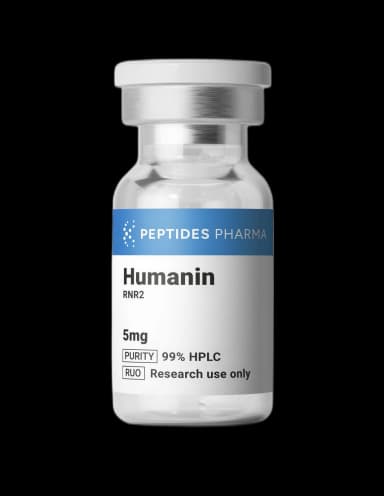
- Full Name: Humanin (HN) - Sequence: Met-Ala-Pro-Arg-Gly-Phe-Ser-Cys-Leu-Leu-Leu-Leu-Thr-Ser-Glu-Ile-Asp-Leu-Pro-Val-Lys-Arg-Arg-Ala - Molecular Weight: 2,687.3 g/mol - Classification: Mitochondria-derived peptide (MDP) - Gene: MT-RNR2 (mitochondrial 16S rRNA) - Half-life: Approximately 30-60 minutes (native form) - Key Analogue: HNG (S14G substitution, 1000x potent) - Receptors: FPRL1, CXCR4, IGFBP-3 (binding partner)
The native Humanin sequence has limited in vivo potency due to rapid proteolytic degradation. Several optimised analogues have been developed, with HNG (Humanin Gly, Ser14→Gly14) being the most widely used. HNG demonstrates approximately 1000-fold greater cytoprotective activity than native Humanin and improved metabolic stability.
Peptides Pharma Humanin vials are manufactured to >99% HPLC purity in GMP-certified facilities with full mass spectrometry verification of sequence identity.
Humanin in the Context of Mitochondrial Peptide Research
Humanin belongs to the mitochondria-derived peptide family alongside MOTS-C and the six SHLPs (Small Humanin-Like Peptides 1-6). Understanding the relationships between these MDPs provides context for comprehensive mitochondrial aging research.
Humanin vs MOTS-C: Both are MDPs but with distinct mechanisms. Humanin acts primarily as an anti-apoptotic factor, preventing cell death through BAX inhibition and STAT3 signalling. MOTS-C acts primarily as a metabolic regulator, activating AMPK to enhance glucose metabolism and fatty acid oxidation. They are complementary rather than redundant.
Humanin vs SS-31: SS-31 is a synthetic peptide that targets mitochondrial structure (cardiolipin binding), while Humanin is an endogenous signalling peptide that prevents apoptotic cascades. SS-31 addresses mitochondrial hardware; Humanin addresses mitochondrial communication.
Humanin + NAD+: NAD+ supports sirtuin-mediated mitochondrial quality control, while Humanin prevents apoptosis in cells under mitochondrial stress. Together, they address both mitochondrial maintenance and the consequences of mitochondrial dysfunction.
Peptides Pharma offers all major mitochondrial research peptides — Humanin, MOTS-C, SS-31, and NAD+ — as high-purity lyophilized vials. Combining these compounds addresses multiple hallmarks of mitochondrial aging through mechanistically distinct pathways. All Humanin UK orders ship with cold-chain packaging and full Certificate of Analysis.