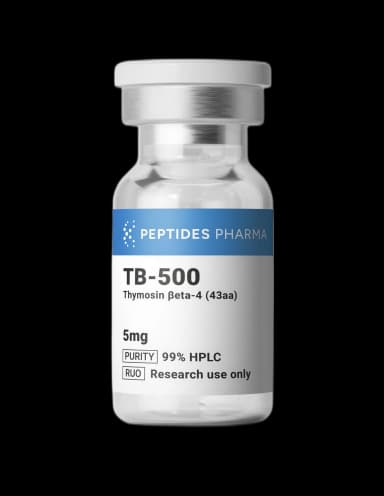
A comprehensive comparison of TB-500 (Thymosin Beta-4) and TB4 FRAG 500 — their molecular structures, research applications, and how they differ for laboratory use.
10 min read · Updated 2026-03-31
What Are TB-500 and TB4 FRAG?
TB-500 and TB4 FRAG are both derived from Thymosin Beta-4 (Tβ4), a 43-amino acid protein naturally produced in nearly all human and animal cells. While they share a common origin, they are distinct compounds with different molecular structures and research profiles.
TB-500 is a synthetic version of the full Thymosin Beta-4 protein. It retains the complete 43-amino acid sequence and replicates the full biological activity of natural Tβ4. TB-500 has been extensively studied for its roles in tissue repair, cell migration, and anti-inflammatory signalling.
TB4 FRAG 500 (also written as TB4 Frag, TB-4 Fragment, or Ac-SDKP) is a shorter peptide fragment derived from the active region of Thymosin Beta-4. It typically consists of the N-terminal tetrapeptide Ac-SDKP (amino acids 1–4) or a longer fragment encompassing the actin-binding domain (amino acids 17–23). These fragments isolate specific functional regions of the parent protein.
Molecular Structure Comparison
Understanding the structural differences between TB-500 and TB4 FRAG is essential for selecting the right compound for your research.
| Property | TB-500 (Full Tβ4) | TB4 FRAG 500 (Ac-SDKP) | |----------|-------------------|-------------------------| | Amino acids | 43 | 4 (Ac-Ser-Asp-Lys-Pro) | | Molecular weight | ~4,963 Da | ~487 Da | | Sequence | Full Thymosin Beta-4 | N-terminal fragment | | Half-life | ~2–3 hours | ~5–10 minutes | | Stability | Moderate | Higher (smaller molecule) | | Production | Recombinant synthesis | Chemical synthesis |
The full-length TB-500 contains multiple functional domains including the actin-binding region (LKKTET, residues 17–22) responsible for G-actin sequestration, as well as regions involved in cell migration, angiogenesis, and anti-inflammatory signalling. TB4 FRAG isolates a single functional domain, offering a more targeted mechanism of action.
RECOMMENDED PRODUCT
Research Applications: TB-500
TB-500 has been the subject of extensive research across multiple fields:
Tissue repair and wound healing: Published studies demonstrate that Tβ4 promotes keratinocyte migration, collagen deposition, and angiogenesis in dermal wound models. Full-length TB-500 activates multiple repair pathways simultaneously.
Cardiac research: Tβ4 has shown cardioprotective properties in ischaemia-reperfusion injury models. It promotes the survival of cardiomyocytes and activates epicardial progenitor cells, suggesting regenerative potential.
Neurological research: Studies indicate Tβ4 promotes oligodendrocyte differentiation and remyelination in CNS injury models, with implications for neurodegenerative conditions.
Anti-inflammatory activity: TB-500 down-regulates inflammatory cytokines including IL-1β, TNF-α, and IL-6, while promoting anti-inflammatory mediator production.
Hair follicle research: Tβ4 is expressed in hair follicle stem cells, and exogenous application has shown effects on hair follicle cycling in murine models.
Research Applications: TB4 FRAG 500
TB4 FRAG (Ac-SDKP) has a more focused research profile:
Anti-fibrotic research: Ac-SDKP is primarily studied for its anti-fibrotic properties. It inhibits collagen synthesis by blocking the TGF-β/Smad signalling pathway, making it relevant to fibrosis research in cardiac, renal, and hepatic models.
Haematopoietic regulation: Ac-SDKP acts as a negative regulator of haematopoietic stem cell proliferation. It keeps stem cells in G0 phase, which is relevant to bone marrow protection research during chemotherapy.
Cardiovascular research: The fragment has demonstrated anti-hypertensive effects in some models, linked to its anti-fibrotic activity and its role in nitric oxide-dependent vasodilation.
ACE inhibitor connection: Ac-SDKP is naturally degraded by angiotensin-converting enzyme (ACE). ACE inhibitor drugs raise endogenous Ac-SDKP levels, which may partly explain some of their cardioprotective effects beyond blood pressure reduction.
RECOMMENDED PRODUCT
TB-500 vs TB4 FRAG: Which to Choose for Your Research
The choice between TB-500 and TB4 FRAG depends entirely on your research objectives:
Choose TB-500 (full-length) when: - Your research requires the complete signalling profile of Thymosin Beta-4 - You are studying wound healing, tissue repair, or cell migration - You need the actin-binding domain (LKKTET) activity - Your protocol calls for multi-pathway activation - You want the most extensively published compound
Choose TB4 FRAG 500 (Ac-SDKP) when: - Your research focuses specifically on anti-fibrotic mechanisms - You need to study TGF-β/Smad pathway modulation in isolation - You are researching haematopoietic stem cell regulation - You require a smaller, more stable peptide for assay conditions - Your study specifically requires the N-terminal fragment
Can they be used together? Some researchers use both in combination protocols to study the differential contributions of the fragment versus the parent protein. However, this requires careful experimental design to distinguish their individual effects.
Dosing in Published Research
Research protocols vary based on the model system and objectives. The following ranges reflect commonly cited dosing in published literature:
TB-500 in published research: - In vitro: 10–100 ng/mL in cell culture media - In vivo (murine): 6–150 μg per animal, typically administered IP - Common research protocol: Loading phase of 2–6 mg/week, maintenance at 2 mg/week (scaled from animal data)
TB4 FRAG 500 (Ac-SDKP) in published research: - In vitro: 0.1–10 nM in cell culture media - In vivo (murine): 400–800 μg/kg/day via osmotic minipump - Note: The very short half-life (~5 minutes) of Ac-SDKP means continuous infusion is preferred in animal studies
Important: These are research reference values from published literature, not dosing recommendations. All Peptides Pharma products are sold strictly for laboratory research use only.
Storage, Stability and Handling
Both peptides require proper handling to maintain integrity:
TB-500: - Store lyophilised powder at -20°C - Reconstituted: stable 7–14 days at 4°C - Avoid repeated freeze-thaw cycles - Reconstitute with bacteriostatic water or sterile saline
TB4 FRAG 500: - More stable in lyophilised form due to smaller molecular weight - Store lyophilised at -20°C - Reconstituted: stable up to 4 weeks at 4°C - Less susceptible to denaturation than the full protein
Peptides Pharma's pre-mixed lyophilized vial eliminates reconstitution uncertainty. Each vial contains precisely dosed, pharmaceutical-grade peptide in a ready-to-use format with a 30-day stability window.