A deep dive into GHK-Cu — the copper-binding peptide transforming skin research. From collagen stimulation to wound remodelling, discover why researchers are turning to this remarkable tripeptide.
9 min read · Updated 2026-03-05
What Is GHK-Cu?
GHK-Cu (glycyl-L-histidyl-L-lysine copper complex) is a naturally occurring copper-binding tripeptide first identified in human plasma by Dr Loren Pickart in 1973. It consists of three amino acids — glycine, histidine, and lysine — bound to a copper(II) ion. This small but powerful peptide is found in blood plasma, saliva, and urine, with concentrations peaking in young adults and declining steadily with age.
Plasma levels of GHK-Cu average approximately 200 ng/mL at age 20, dropping to around 80 ng/mL by age 60. This age-related decline has made GHK-Cu a focal point of anti-ageing and regenerative research. The peptide's ability to bind copper is central to its biological activity, as copper ions serve as essential cofactors for numerous enzymes involved in tissue repair, antioxidant defence, and extracellular matrix remodelling.
Unlike many synthetic peptides, GHK-Cu has a long history of human exposure through its natural presence in the body, lending additional interest to its research profile.
Mechanism of Action: How GHK-Cu Works
GHK-Cu exerts its effects through multiple interconnected biological pathways, making it one of the most versatile peptides studied in dermatological and regenerative research.
Collagen Synthesis and Extracellular Matrix Remodelling GHK-Cu has been shown to stimulate collagen types I, III, and V — the primary structural proteins of the skin. It simultaneously promotes the production of decorin, a proteoglycan that regulates collagen fibril assembly and organisation. This dual action not only increases collagen quantity but also improves the structural quality of newly formed collagen networks.
Metalloproteinase Regulation The peptide modulates matrix metalloproteinases (MMPs) and their inhibitors (TIMPs). By balancing the breakdown and synthesis of extracellular matrix components, GHK-Cu supports controlled tissue remodelling rather than unregulated degradation — a key distinction in anti-ageing research.
Antioxidant Defence GHK-Cu upregulates the expression of superoxide dismutase (SOD), a critical antioxidant enzyme that neutralises superoxide radicals. This helps protect cells from oxidative stress, a primary driver of skin ageing and tissue damage.
Growth Factor Stimulation Research demonstrates that GHK-Cu stimulates fibroblast growth factor (FGF), vascular endothelial growth factor (VEGF), and nerve growth factor (NGF). These growth factors support wound healing, angiogenesis, and nerve regeneration respectively.
Gene Expression Modulation A landmark 2014 study revealed that GHK-Cu modulates the expression of over 4,000 human genes, shifting patterns towards a healthier, more youthful profile. This broad gene-regulatory activity is thought to underpin its wide-ranging biological effects.
RECOMMENDED PRODUCT
Key Research Areas for GHK-Cu
Skin Ageing and Rejuvenation GHK-Cu is arguably the most studied peptide in skin ageing research. Multiple studies have demonstrated its ability to improve skin thickness, elasticity, and firmness in ageing skin models. A controlled study by Leyden et al. showed that GHK-Cu cream applied twice daily for 12 weeks significantly increased skin thickness and reduced fine lines compared to placebo and vitamin C controls.
Wound Healing GHK-Cu accelerates wound closure through several mechanisms: stimulating fibroblast migration, promoting angiogenesis (new blood vessel formation), and attracting immune cells to the wound site. Copper ions delivered by GHK-Cu also have inherent antimicrobial properties, reducing infection risk in wound models.
Hair Follicle Research Emerging research suggests GHK-Cu may support hair follicle health. By increasing blood supply to follicles, stimulating dermal papilla cells, and modulating the Wnt signalling pathway, GHK-Cu has shown promise in hair growth research. Several studies have demonstrated increased hair follicle size and improved hair thickness in treated areas.
Scar Remodelling GHK-Cu's ability to regulate collagen organisation and MMP activity makes it of particular interest for scar research. Studies indicate it promotes more organised collagen deposition — closer to normal skin architecture — rather than the disordered collagen bundles typical of scar tissue.
Anti-Inflammatory Effects The peptide reduces pro-inflammatory cytokines including IL-6, TNF-alpha, and TGF-beta, positioning it as a research tool for studying inflammation-driven skin conditions and age-related inflammatory processes.
GHK-Cu vs Other Copper Peptides
Not all copper peptides are created equal. The research peptide market includes several copper-containing compounds, but GHK-Cu stands apart:
GHK-Cu (Tripeptide-1 Copper) - Three amino acids bound to copper(II) - The most extensively researched copper peptide - Over 60 published studies spanning five decades - Naturally occurring in human plasma - Gene-modulatory activity confirmed at 4,000+ genes
AHK-Cu (Tripeptide-3 Copper) - Synthetic analogue with alanine substituted for glycine - Fewer published studies, primarily in cosmetic contexts - Similar collagen-stimulating properties in vitro
Copper Gluconate / Copper PCA - Simple copper salts, not true peptide-copper complexes - Lack the targeted biological activity of GHK-Cu - Copper delivery is less controlled
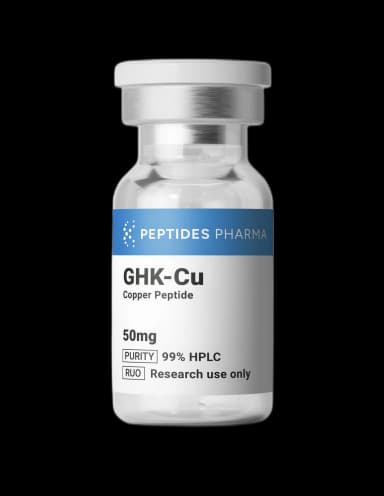
For rigorous research applications, GHK-Cu remains the gold standard due to its extensive evidence base and well-characterised biological activity. Peptides Pharma's GHK-Cu vial delivers the authentic tripeptide-copper complex at pharmaceutical-grade purity (>99%).
RECOMMENDED PRODUCT
Molecular Profile and Pharmacology
Understanding GHK-Cu's molecular characteristics is essential for designing effective research protocols:
- Molecular Formula: C₁₄H₂₃CuN₆O₄ - Molecular Weight: 403.92 g/mol - Sequence: Gly-His-Lys·Cu²⁺ - Classification: Metallopeptide (copper-binding tripeptide) - Copper Binding Affinity: Kd ≈ 10⁻¹⁶ M (extremely high affinity) - Solubility: Freely soluble in water and aqueous buffers - Stability: Stable at physiological pH (6.5–7.5); degrades in strongly acidic or alkaline conditions - Half-life: Estimated 2–4 hours following subcutaneous administration
The exceptionally high copper-binding affinity ensures that the copper ion remains complexed with the peptide during transit, delivering it directly to target tissues rather than releasing free copper ions into circulation. This targeted copper delivery is a significant advantage over non-peptide copper supplements.
GHK-Cu's small size (just three amino acids) allows efficient penetration through biological barriers, including the skin — making it suitable for both topical and injectable research applications.
Peptides Pharma GHK-Cu Vial: Specifications and Usage
Peptides Pharma delivers GHK-Cu in a lyophilized vial engineered for consistent, research-grade administration:
- Dosage: 10 mg per vial - Volume: 3 mL pre-mixed solution - Purity: >99% (HPLC verified, CoA included) - Dosing Period: 30 days - Sterilisation: 0.22μm filtration + gamma ray sterilisation - Storage: 2–8°C refrigerated - Shelf Life: 24 months - Manufacturing: GMP-certified facility (Switzerland)
Why choose Peptides Pharma's GHK-Cu vial over vials? Traditional GHK-Cu vials require reconstitution with bacteriostatic water, introducing dosing variability and contamination risk. Peptides Pharma's lyophilized vial eliminates these variables entirely. Each click delivers a precise, factory-calibrated dose — ensuring research consistency from first administration to last.
The vial system is particularly advantageous for GHK-Cu research because the sealed cartridge protects the copper-peptide complex from oxidation, a common degradation pathway for metallopeptides exposed to air during vial reconstitution.
Peptides Pharma ships GHK-Cu vials with worldwide delivery, temperature-controlled packaging, and full certificates of analysis.