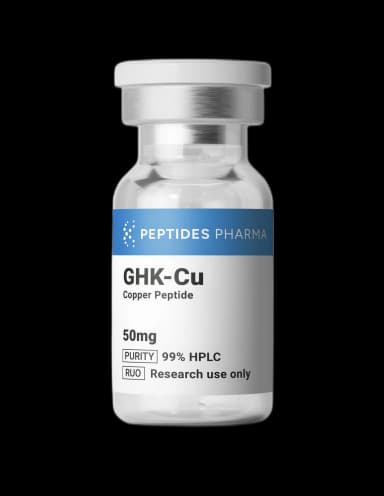
What is GHK-Cu?
GHK-Cu (Glycyl-L-Histidyl-L-Lysine Copper Complex) is classified as a copper tripeptide / matrikine. With a molecular weight of 403.92 Da and formula C14H24CuN6O4, it is one of the most studied compounds in its class.
This encyclopedia entry covers the molecular profile, mechanism of action, research history, key published studies, and research applications of GHK-Cu. It is part of the Peptides Pharma Peptide Encyclopedia, a scientific reference for researchers working with peptide compounds.
Molecular Profile
MOLECULAR FORMULA
C14H24CuN6O4
MOLECULAR WEIGHT
403.92 Da
CLASSIFICATION
Copper Tripeptide / Matrikine
AMINO ACID SEQUENCE / STRUCTURE
Gly-His-Lys (copper-bound tripeptide)
Mechanism of Action
GHK-Cu (glycyl-L-histidyl-L-lysine copper) is a naturally occurring tripeptide with a remarkably high affinity for copper(II) ions. It functions as a matrikine — a small peptide derived from extracellular matrix proteins that signals tissue repair and remodelling processes.
The peptide activates multiple regenerative pathways simultaneously. It stimulates collagen types I and III synthesis, increases elastin production, and promotes glycosaminoglycan (GAG) accumulation — including hyaluronic acid — in the extracellular matrix. Through TGF-beta modulation, it regulates the balance between tissue deposition and degradation, promoting remodelling rather than fibrosis.
GHK-Cu also acts as a potent antioxidant by modulating superoxide dismutase (SOD) and serves as an anti-inflammatory agent by suppressing the production of TGF-beta 1 and other fibrotic cytokines. Recent genomic studies have shown it can reset the expression of over 4,000 genes toward a healthier, younger state — affecting DNA repair pathways, oxidative stress response, and stem cell biology. This broad gene-resetting capability is unique among peptides and underlies its diverse applications in skin science, wound healing, and hair follicle research.
Research History
GHK-Cu was first identified in human plasma in 1973 by Dr. Loren Pickart, who observed that plasma from young individuals (age 20-25) could stimulate older liver cells to produce proteins characteristic of younger tissue. The active factor was isolated and identified as a tripeptide complexed with copper.
Since its discovery, over 70 published studies have investigated GHK-Cu's properties. Research in the 1980s-1990s focused on wound healing and skin biology, establishing its role in collagen synthesis and tissue remodelling. The 2010s brought a revolution when broad gene expression studies revealed GHK-Cu could modulate thousands of genes — far more than expected for such a small molecule — opening new avenues in anti-aging, regenerative medicine, and cancer biology research.
Key Published Studies
The human tripeptide GHK-Cu in the prevention of oxidative stress and degenerative conditions of aging
2012
Demonstrated GHK-Cu resets the expression of 4,000+ human genes, with broad anti-aging effects on DNA repair, oxidative stress response, and tissue remodelling pathways.
GHK-Cu promotes hair follicle growth and increases follicle size
2007
Showed GHK-Cu enlarges hair follicles, extends the anagen (growth) phase, and stimulates dermal papilla cell proliferation — key findings for hair loss research.
Copper peptide GHK-Cu and skin collagen synthesis
2000
Established that GHK-Cu stimulates collagen I and III synthesis in human fibroblasts, with effects exceeding those of retinoic acid in controlled comparisons.
Anti-inflammatory activity of the peptide GHK-Cu after acute lung injury
2015
Demonstrated potent anti-inflammatory effects in lung tissue, reducing TNF-alpha and IL-6 while promoting tissue repair — expanding applications beyond dermatology.
Research Applications
Skin rejuvenation and anti-aging research
Collagen and elastin synthesis studies
Hair follicle growth and alopecia research
Wound healing acceleration
Anti-inflammatory and antioxidant research
Gene expression and epigenetic studies
Scar reduction and tissue remodelling
RECOMMENDED PRODUCT