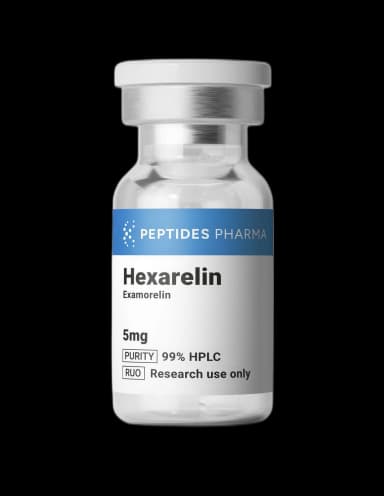
Hexarelin (Examorelin) is the most potent synthetic GH secretagogue by weight, with unique cardioprotective properties mediated through CD36 receptor binding independent of GH release.
10 min read · Updated 2026-04-03
What Is Hexarelin (Examorelin)?
Hexarelin, also known as Examorelin or HEX, is a synthetic hexapeptide growth hormone secretagogue with the sequence His-D-2-methyl-Trp-Ala-Trp-D-Phe-Lys-NH2. It is structurally related to GHRP-6 but includes a 2-methyl modification on the D-tryptophan residue that dramatically increases its potency, making Hexarelin the most powerful GH secretagogue by weight in its class.
Developed in the early 1990s, Hexarelin has been evaluated in multiple clinical studies and reached Phase 2 clinical trials for growth hormone deficiency. While it was not ultimately approved as a therapeutic agent — primarily due to tachyphylaxis concerns with chronic dosing — its pharmacological profile has made it an invaluable research tool for understanding GH-axis physiology.
What distinguishes Hexarelin from other GH secretagogues is its dual mechanism: it stimulates GH release through the GHS-R1a receptor on pituitary somatotrophs, but it also binds the CD36 scavenger receptor, exerting direct cardioprotective effects entirely independent of growth hormone. This cardiac action has generated significant research interest in cardiovascular biology.
Hexarelin research continues to expand our understanding of both GH physiology and cardiac protection, making it a compound of interest across multiple research domains.
Mechanism of Action: GHS-R1a and CD36 Dual Targeting
Hexarelin's mechanism encompasses two distinct receptor systems, each mediating different biological effects.
GHS-R1a (Ghrelin Receptor) Pathway: Like other GH secretagogues, Hexarelin binds GHS-R1a on anterior pituitary somatotrophs, triggering phospholipase C activation, IP3-mediated calcium release, and GH vesicle exocytosis. Hexarelin produces the highest peak GH response of any synthetic secretagogue — approximately 2-3 times greater than GHRP-6 and 5-10 times greater than ipamorelin at equivalent doses. It also stimulates GHRH neurons and suppresses somatostatin, amplifying the GH response through hypothalamic circuits.
CD36 Receptor Pathway: Hexarelin uniquely binds the CD36 scavenger receptor, a class B pattern recognition receptor expressed on cardiomyocytes, macrophages, and endothelial cells. CD36 binding in cardiac tissue activates PPARγ-dependent signalling cascades that reduce oxidative stress, inhibit apoptosis, and promote cardiomyocyte survival. This mechanism operates independently of GH release — Hexarelin protects cardiac tissue even in hypophysectomised animals lacking a functional pituitary.
Research suggests that Hexarelin's CD36 activation also modulates macrophage foam cell formation, a key step in atherosclerotic plaque development. By altering the uptake and processing of oxidised low-density lipoprotein (oxLDL) through CD36, Hexarelin may influence atherogenesis — an area of active investigation.
The dual-receptor pharmacology of Hexarelin makes it uniquely valuable for researchers studying the intersection of growth hormone biology and cardiovascular protection.
RECOMMENDED PRODUCT
Cardioprotective Research: Beyond Growth Hormone
Hexarelin's cardioprotective effects have been documented across multiple experimental models and represent its most distinctive research application. Unlike other GH secretagogues, whose cardiac benefits are secondary to GH-mediated IGF-1 elevation, Hexarelin acts directly on cardiac tissue.
In ischaemia-reperfusion models, Hexarelin pre-treatment significantly reduced infarct size, preserved left ventricular function, and decreased cardiomyocyte apoptosis. These effects were replicated in GH-deficient animals and in isolated perfused hearts, confirming independence from the GH axis. The mechanism involves PPARγ activation, mitochondrial permeability transition pore stabilisation, and upregulation of anti-apoptotic Bcl-2 family proteins.
Studies in cardiac fibrosis models demonstrated that Hexarelin reduced collagen deposition and TGF-β signalling, suggesting potential applications in heart failure research where fibrotic remodelling drives disease progression. The CD36-PPARγ axis is known to regulate fibrotic gene expression in multiple tissues, and Hexarelin provides a pharmacological tool to interrogate this pathway.
Clinical data from Phase 2 trials documented improvements in left ventricular ejection fraction and cardiac output in patients with GH deficiency, though separating GH-dependent from GH-independent effects was challenging in this population. Dedicated cardiac trials specifically investigating the CD36-mediated mechanism have been proposed but not yet completed.
Buy Hexarelin research vials from Peptides Pharma for cardiovascular and GH-axis protocols. All Hexarelin vials ship with full Certificate of Analysis confirming >99% purity.
Hexarelin Molecular Profile
- Full Name: Hexarelin / Examorelin / HEX - Sequence: His-D-2-Me-Trp-Ala-Trp-D-Phe-Lys-NH2 - Molecular Formula: C₄₇H₅₈N₁₂O₆ - Molecular Weight: 887.04 g/mol - Classification: Synthetic hexapeptide GH secretagogue - Primary Receptor: GHS-R1a (ghrelin receptor) - Secondary Receptor: CD36 (scavenger receptor) - Half-life: Approximately 60-70 minutes - Peak GH Response: 15-20 minutes post-injection
The 2-methylation of the D-tryptophan residue at position 2 is the key structural modification that distinguishes Hexarelin from GHRP-6. This seemingly minor change increases receptor binding affinity and GH secretory potency by approximately 2-3 fold while also conferring CD36 binding activity.
Peptides Pharma Hexarelin is manufactured in GMP-certified facilities with >99% HPLC purity. Each vial includes full Certificate of Analysis with HPLC chromatogram and mass spectrometry data.
RECOMMENDED PRODUCT
Tachyphylaxis: The Key Limitation of Hexarelin
The most significant pharmacological limitation of Hexarelin is tachyphylaxis — the progressive reduction in GH response with repeated dosing. This receptor desensitisation is more pronounced with Hexarelin than with other GH secretagogues, likely due to its higher receptor binding affinity causing more complete GHS-R1a internalisation.
Studies demonstrate that daily Hexarelin administration produces maximal GH responses for the first 4-8 weeks, followed by a progressive decline. By 12-16 weeks of continuous use, GH responses may be attenuated by 50% or more compared to initial values. This tachyphylaxis was a primary reason Hexarelin was not advanced beyond Phase 2 clinical trials for chronic GH deficiency treatment.
Researchers have developed several strategies to mitigate Hexarelin tachyphylaxis. Intermittent dosing protocols — such as 5 days on, 2 days off, or 3 weeks on, 1 week off — allow partial receptor resensitisation and maintain higher GH responses over extended research periods. Co-administration with GHRH analogues like CJC-1295 may also sustain responses, as GHRH receptor signalling is not subject to the same desensitisation.
Importantly, Hexarelin's CD36-mediated cardioprotective effects do not appear to undergo tachyphylaxis. This suggests that the cardiovascular benefits may persist during chronic administration even as GH-releasing efficacy declines — a finding with significant implications for cardiac research protocols.
Research Protocols and Dosing
Published Hexarelin research protocols vary by research objective, but the following dosing ranges are representative of the peer-reviewed literature.
For acute GH-axis characterisation, single doses of 1-2 mcg/kg body weight are typically used. This produces a reliable, high-amplitude GH pulse suitable for diagnostic assessment of pituitary GH reserve.
For chronic research protocols, 1-2 mcg/kg administered 1-3 times daily via subcutaneous injection is standard. Given tachyphylaxis concerns, many researchers employ intermittent dosing schedules with 2-day rest periods per week or 1-week rest periods per month.
For cardioprotection research specifically, protocols often use lower doses (0.5-1 mcg/kg) that may be sufficient for CD36 activation without maximally stimulating GH release. This allows investigation of cardiac effects while minimising tachyphylaxis.
Hexarelin synergises with CJC-1295 through complementary receptor mechanisms. Combined protocols use standard doses of both compounds administered simultaneously, producing amplified and sustained GH release. Peptides Pharma offers both Hexarelin and CJC-1295 research vials with worldwide delivery and full COA documentation.