What is CJC-1295?
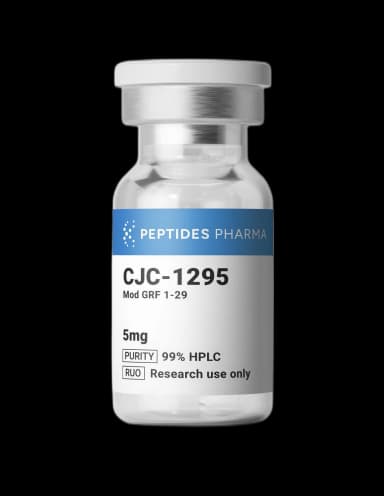
CJC-1295 (CJC-1295 (Modified Growth Hormone Releasing Factor 1-29)) is classified as a growth hormone-releasing hormone (ghrh) analogue. With a molecular weight of 3367.97 Da and formula C152H252N44O42, it is one of the most studied compounds in its class.
This encyclopedia entry covers the molecular profile, mechanism of action, research history, key published studies, and research applications of CJC-1295. It is part of the Peptides Pharma Peptide Encyclopedia, a scientific reference for researchers working with peptide compounds.
Molecular Profile
MOLECULAR FORMULA
C152H252N44O42
MOLECULAR WEIGHT
3367.97 Da
CLASSIFICATION
Growth Hormone-Releasing Hormone (GHRH) Analogue
AMINO ACID SEQUENCE / STRUCTURE
Modified GRF(1-29) with Drug Affinity Complex (DAC) technology
Mechanism of Action
CJC-1295 is a synthetic analogue of growth hormone-releasing hormone (GHRH) that binds to the GHRH receptor on somatotroph cells in the anterior pituitary gland. Upon receptor activation, it stimulates the synthesis and pulsatile release of growth hormone (GH) into the bloodstream.
What distinguishes CJC-1295 from natural GHRH is its extended half-life. Through amino acid substitutions at positions 2, 8, 15, and 27 of the native GRF(1-29) sequence, CJC-1295 resists enzymatic degradation by dipeptidyl peptidase-IV (DPP-IV), which normally cleaves GHRH within minutes. Some formulations also incorporate Drug Affinity Complex (DAC) technology, which enables the peptide to bind to circulating albumin, further extending its duration of action to several days.
The resulting sustained GH elevation promotes downstream IGF-1 (Insulin-like Growth Factor-1) production in the liver, which mediates many of GH's anabolic, metabolic, and regenerative effects — including protein synthesis, fat oxidation, bone mineralisation, and tissue repair.
Research History
CJC-1295 was developed in the mid-2000s by ConjuChem Biotechnologies (now Conjuchem LLC) as a long-acting GHRH analogue designed to overcome the ultra-short half-life of endogenous GHRH. The original formulation with DAC (Drug Affinity Complex) showed dramatic increases in mean GH and IGF-1 levels in human trials.
A Phase II clinical trial published in 2006 demonstrated that a single subcutaneous injection of CJC-1295 DAC could elevate GH levels for 6-8 days and IGF-1 levels for up to 28 days. The no-DAC version (often called Mod GRF 1-29) has a shorter duration but remains one of the most studied GHRH analogues in peptide research, often combined with ghrelin mimetics like Ipamorelin for synergistic GH release.
Key Published Studies
Prolonged stimulation of growth hormone and insulin-like growth factor I secretion by CJC-1295
2006
A single dose elevated GH levels 2-10 fold and IGF-1 levels 1.5-3 fold for up to 28 days in healthy adults.
Effects of a growth hormone-releasing hormone analog on sleep in healthy men
2008
Demonstrated increased slow-wave (deep) sleep duration and improved sleep quality in subjects receiving GHRH analogue treatment.
Synergistic effects of GHRH and GHRP on pulsatile GH secretion
2009
Showed combining GHRH analogues with ghrelin-pathway peptides produces synergistic rather than merely additive GH release.
CJC-1295 effects on body composition and metabolic markers
2012
Reported improvements in lean body mass, fat reduction, and metabolic markers in subjects with sustained GH elevation.
Research Applications
Growth hormone secretion research
Body composition and metabolism studies
Sleep quality improvement research
IGF-1 elevation protocols
Anti-aging and longevity studies
Synergistic GH release with ghrelin mimetics
Recovery and regeneration research
RECOMMENDED PRODUCT