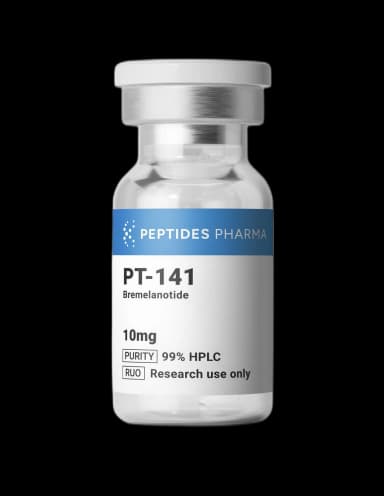
What is PT-141?
PT-141 (PT-141 / Bremelanotide (Melanocortin Receptor Agonist)) is classified as a melanocortin receptor agonist (mc3r/mc4r). With a molecular weight of 1025.18 Da and formula C50H68N14O10, it is one of the most studied compounds in its class.
This encyclopedia entry covers the molecular profile, mechanism of action, research history, key published studies, and research applications of PT-141. It is part of the Peptides Pharma Peptide Encyclopedia, a scientific reference for researchers working with peptide compounds.
Molecular Profile
MOLECULAR FORMULA
C50H68N14O10
MOLECULAR WEIGHT
1025.18 Da
CLASSIFICATION
Melanocortin Receptor Agonist (MC3R/MC4R)
AMINO ACID SEQUENCE / STRUCTURE
Ac-Nle-cyclo[Asp-His-D-Phe-Arg-Trp-Lys]-OH (cyclic heptapeptide)
Mechanism of Action
PT-141 (Bremelanotide) is a synthetic cyclic heptapeptide that acts as a non-selective agonist at melanocortin receptors, with primary activity at MC3R and MC4R subtypes located in the central nervous system. Unlike phosphodiesterase inhibitors that act peripherally on vascular smooth muscle, PT-141 exerts its effects through central nervous system pathways in the hypothalamus.
Melanocortin-4 receptors (MC4R) in the hypothalamus are critical regulators of sexual arousal, appetite, and energy homeostasis. When PT-141 activates MC4R, it initiates a dopaminergic cascade in the medial preoptic area and paraventricular nucleus, stimulating the neural pathways responsible for sexual desire and arousal. This central mechanism means PT-141 addresses the motivational/desire component of sexual function, not merely the vascular/mechanical component.
PT-141 also demonstrates activity at MC3R, which contributes to energy homeostasis and inflammatory regulation. The compound was derived from the linear peptide alpha-MSH analogue Melanotan II through removal of the C-terminal amide, which eliminated the tanning effects while preserving melanocortin receptor agonism relevant to sexual function.
Research History
PT-141 originated from research into Melanotan II (MT-II), an alpha-melanocyte-stimulating hormone (alpha-MSH) analogue developed at the University of Arizona in the 1990s for sunless tanning. During clinical trials of MT-II, researchers unexpectedly observed that the compound consistently produced spontaneous penile erections in male subjects — an effect not attributable to its melanogenic properties.
Palatin Technologies subsequently developed PT-141 (Bremelanotide) by modifying the MT-II structure to isolate the sexual function effects from tanning activity. Phase II and Phase III clinical trials demonstrated efficacy in both male erectile dysfunction (particularly in patients who did not respond to PDE5 inhibitors) and female hypoactive sexual desire disorder (HSDD). In 2019, the FDA approved Bremelanotide under the brand name Vyleesi for the treatment of acquired, generalised HSDD in premenopausal women — making it the first melanocortin-based therapy approved for sexual dysfunction and only the second drug ever approved for female sexual desire disorders.
Key Published Studies
Bremelanotide for female sexual dysfunctions: the RECONNECT Phase III trials
2019
Two pivotal Phase III trials in premenopausal women with HSDD demonstrated statistically significant improvements in sexual desire and reduction in distress, leading to FDA approval of Vyleesi.
Melanocortin receptor agonists in the treatment of male erectile dysfunction
2005
Demonstrated that PT-141 produced erections in 67% of men with ED who had previously failed sildenafil treatment, confirming its novel central mechanism distinct from PDE5 inhibitors.
MC4R activation and the central dopaminergic pathways of sexual arousal
2008
Characterised the neural pathway: MC4R activation in the hypothalamus triggers dopamine release in the medial preoptic area, establishing the mechanistic basis for PT-141's pro-sexual effects.
Bremelanotide: pharmacology and clinical development for sexual dysfunction
2016
Comprehensive pharmacological review establishing PT-141's selectivity for MC3R/MC4R, its central mechanism of action, and clinical efficacy data across multiple Phase II trials in both sexes.
Research Applications
Sexual dysfunction and desire disorder research
Melanocortin receptor biology and pharmacology
Central nervous system arousal mechanisms
Hypothalamic dopaminergic pathway studies
Female sexual health and HSDD research
PDE5 inhibitor-refractory erectile dysfunction
Melanocortin-based therapeutic development
RECOMMENDED PRODUCT