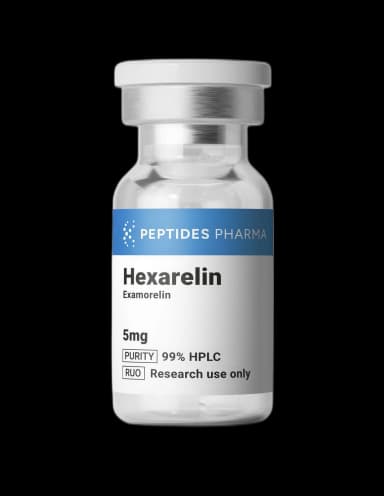
What is Hexarelin?
Hexarelin (Examorelin (Hexarelin)) is classified as a synthetic hexapeptide growth hormone secretagogue. With a molecular weight of 903.04 Da and formula C47H58N12O6, it is one of the most studied compounds in its class.
This encyclopedia entry covers the molecular profile, mechanism of action, research history, key published studies, and research applications of Hexarelin. It is part of the Peptides Pharma Peptide Encyclopedia, a scientific reference for researchers working with peptide compounds.
Molecular Profile
MOLECULAR FORMULA
C47H58N12O6
MOLECULAR WEIGHT
903.04 Da
CLASSIFICATION
Synthetic Hexapeptide Growth Hormone Secretagogue
AMINO ACID SEQUENCE / STRUCTURE
His-D-2-Me-Trp-Ala-Trp-D-Phe-Lys-NH2
Mechanism of Action
Hexarelin is a synthetic hexapeptide growth hormone secretagogue that acts primarily through the growth hormone secretagogue receptor (GHS-R1a), also known as the ghrelin receptor, on somatotroph cells in the anterior pituitary gland. Upon binding, it triggers a robust, dose-dependent release of growth hormone (GH) into the bloodstream. Research suggests that hexarelin produces one of the strongest GH responses among synthetic secretagogues, with peak GH levels significantly exceeding those achieved by GHRP-6 or GHRP-2 at comparable doses.
Beyond the pituitary axis, hexarelin has demonstrated direct cardioprotective effects that appear to be independent of GH release. Studies indicate that it binds to a distinct cardiac receptor — now identified as CD36, a scavenger receptor involved in fatty acid transport and atherosclerotic plaque formation. Through this pathway, hexarelin has been shown to protect cardiomyocytes from ischaemia-reperfusion injury, reduce infarct size, and improve cardiac function in animal models of heart disease.
Hexarelin also stimulates the release of ACTH, cortisol, and prolactin to a greater degree than more selective secretagogues like ipamorelin. While this broader hormonal activation limits its selectivity, it has made hexarelin a valuable research tool for studying the interplay between the somatotropic, adrenal, and lactotropic axes. Its resistance to enzymatic degradation, conferred by the D-amino acid substitutions at positions 2 and 5, gives it a functional half-life suitable for experimental protocols.
Research History
Hexarelin was first synthesised in the early 1990s by a team led by Romano Deghenghi at Europeptides, as part of a systematic effort to develop potent growth hormone-releasing peptides. It was derived by modifying the structure of GHRP-6, incorporating a 2-methyl-tryptophan substitution and D-phenylalanine to enhance receptor binding affinity and metabolic stability. Early clinical studies published between 1994 and 1997 confirmed its potent GH-releasing activity in both healthy volunteers and GH-deficient patients, establishing it as the most potent hexapeptide secretagogue of its class.
Subsequent research through the 2000s shifted attention to hexarelin's cardiovascular properties. Landmark studies demonstrated its ability to reduce cardiac fibrosis, prevent ventricular remodelling after myocardial infarction, and protect against doxorubicin-induced cardiotoxicity. The discovery that these cardioprotective effects were mediated through CD36 rather than GHS-R1a opened an entirely new avenue of research. However, clinical development was complicated by the observation that hexarelin's GH-releasing efficacy diminishes with repeated administration due to receptor desensitisation, a finding that has directed research toward intermittent dosing strategies and combination protocols.
Key Published Studies
Growth hormone-releasing activity of hexarelin, a new synthetic hexapeptide
1994
Demonstrated that hexarelin produces a dose-dependent GH release in healthy humans, with peak levels 3-5 fold higher than those achieved by GHRP-6 at equivalent doses.
Hexarelin protects the heart from ischaemia-reperfusion injury via CD36
2003
Identified CD36 as the cardiac receptor mediating hexarelin's cardioprotective effects, showing a 40% reduction in infarct size independent of GH release.
Hexarelin prevents doxorubicin-induced cardiotoxicity in rats
2005
Showed that hexarelin administration significantly attenuated doxorubicin-induced cardiac damage, preserving left ventricular function and reducing cardiomyocyte apoptosis.
Desensitisation of the GH response to repeated hexarelin administration
2000
Documented progressive attenuation of GH release with continuous hexarelin dosing, with partial recovery following washout periods, informing intermittent dosing protocols.
Hexarelin reduces cardiac fibrosis and ventricular remodelling post-MI
2009
Research indicated significant reductions in collagen deposition and improved ejection fraction in post-myocardial infarction rat models treated with hexarelin.
Research Applications
Growth hormone secretion research
Cardioprotection and ischaemia-reperfusion studies
CD36 receptor signalling research
Cardiac fibrosis and remodelling studies
Doxorubicin cardiotoxicity protection research
GHS-R1a receptor pharmacology
Neuroendocrine axis interaction studies
RECOMMENDED PRODUCT