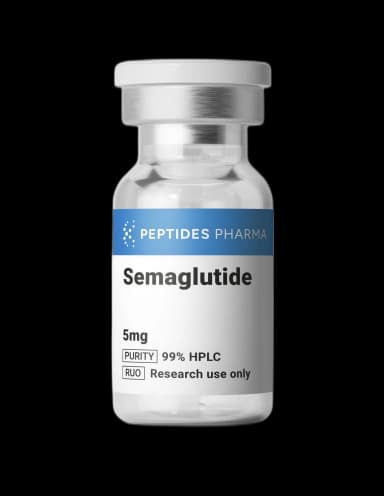
What is Semaglutide?
Semaglutide (Semaglutide (GLP-1 Receptor Agonist)) is classified as a glp-1 receptor agonist (incretin mimetic). With a molecular weight of 4113.58 Da and formula C187H291N45O59, it is one of the most studied compounds in its class.
This encyclopedia entry covers the molecular profile, mechanism of action, research history, key published studies, and research applications of Semaglutide. It is part of the Peptides Pharma Peptide Encyclopedia, a scientific reference for researchers working with peptide compounds.
Molecular Profile
MOLECULAR FORMULA
C187H291N45O59
MOLECULAR WEIGHT
4113.58 Da
CLASSIFICATION
GLP-1 Receptor Agonist (Incretin Mimetic)
AMINO ACID SEQUENCE / STRUCTURE
Modified GLP-1(7-37) analogue with C18 fatty diacid chain (31-amino acid backbone)
Mechanism of Action
Semaglutide is a long-acting analogue of human glucagon-like peptide-1 (GLP-1) that binds to and activates the GLP-1 receptor with high affinity. Endogenous GLP-1 is an incretin hormone secreted by intestinal L-cells following food intake, but its native form has a half-life of only 1-2 minutes due to rapid degradation by dipeptidyl peptidase-4 (DPP-4).
Semaglutide overcomes this limitation through two key modifications: an amino acid substitution at position 8 (Ala8Aib) that confers DPP-4 resistance, and a C18 fatty diacid chain attached via a linker at position 26 that enables strong non-covalent binding to serum albumin. These modifications extend the half-life to approximately 7 days, enabling once-weekly dosing.
Upon GLP-1 receptor activation, semaglutide exerts multiple physiological effects: it enhances glucose-dependent insulin secretion from pancreatic beta cells, suppresses glucagon release from alpha cells, delays gastric emptying, and — critically for weight management — acts on GLP-1 receptors in the hypothalamus and brainstem to reduce appetite and increase satiety. The central nervous system effects on appetite regulation are believed to be the primary driver of the substantial weight loss observed in clinical trials.
Research History
Semaglutide was developed by Novo Nordisk, building on decades of incretin biology research that began with the discovery of GLP-1's insulinotropic effects in the 1980s. The first GLP-1 receptor agonist, exenatide, was approved in 2005, but its twice-daily dosing was a limitation. Liraglutide (once-daily) followed in 2010.
Semaglutide represented a generational advance with once-weekly subcutaneous dosing (Ozempic, approved 2017 for type 2 diabetes) and later an oral formulation (Rybelsus, 2019) — the first oral GLP-1 agonist. The landmark STEP clinical trial programme then demonstrated unprecedented weight loss efficacy: the 2021 STEP 1 trial showed 14.9% mean body weight reduction at 68 weeks, leading to FDA approval of Wegovy for chronic weight management. Semaglutide has since become one of the most prescribed and publicly discussed pharmaceutical compounds worldwide.
Key Published Studies
STEP 1: Once-weekly semaglutide 2.4 mg for weight management
2021
Demonstrated 14.9% mean body weight reduction over 68 weeks in adults with obesity, with 86% of participants losing at least 5% of body weight.
SUSTAIN-6: Cardiovascular outcomes with semaglutide in type 2 diabetes
2016
Showed a 26% reduction in major adverse cardiovascular events (MACE) in patients with type 2 diabetes, establishing cardiovascular safety and benefit.
SELECT: Semaglutide and cardiovascular outcomes in obesity
2023
Demonstrated a 20% reduction in major cardiovascular events in overweight/obese adults without diabetes — the first weight-loss drug to show cardiovascular benefit independent of diabetes.
OASIS 1: Oral semaglutide 50mg for weight management
2023
Showed that higher-dose oral semaglutide achieved 15.1% weight loss at 68 weeks, approaching the efficacy of injectable formulations.
Research Applications
Weight management and obesity research
Type 2 diabetes and glycaemic control
Cardiovascular risk reduction studies
Appetite regulation and satiety mechanisms
Metabolic syndrome research
Non-alcoholic steatohepatitis (NASH) studies
Incretin biology and GLP-1 receptor pharmacology
RECOMMENDED PRODUCT