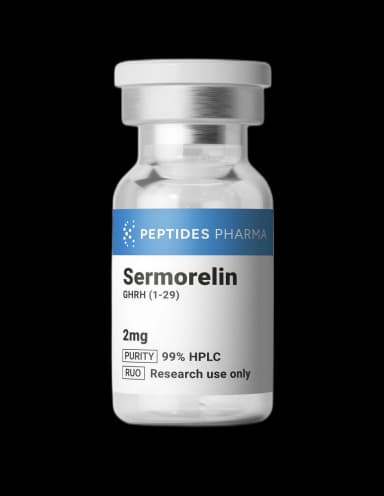
Sermorelin is a synthetic 29-amino acid analogue of growth hormone releasing hormone (GHRH 1-29) that stimulates physiological GH release while preserving pituitary negative feedback mechanisms.
10 min read · Updated 2026-04-03
What Is Sermorelin?
Sermorelin acetate is a synthetic peptide consisting of the first 29 amino acids of the 44-amino acid endogenous growth hormone releasing hormone (GHRH). This N-terminal fragment, designated GHRH(1-29)NH2, retains the full biological activity of the complete GHRH molecule, as the first 29 residues contain the entire receptor binding domain required for pituitary GH stimulation.
Developed by the pharmaceutical company Serono (now part of EMD Serono/Merck KGaA), Sermorelin was FDA-approved in 1997 under the trade name Geref for the diagnosis and treatment of growth hormone deficiency in children. Although commercial production of Geref was discontinued in 2008 for business reasons rather than safety concerns, Sermorelin remains available as a compounded medication and as a research peptide.
Sermorelin represents the most physiological approach to GH-axis stimulation among available peptide tools. It acts exclusively through the GHRH receptor (GHRH-R) on pituitary somatotrophs, stimulating GH synthesis and secretion through the same pathway as endogenous GHRH. Crucially, Sermorelin preserves all physiological negative feedback mechanisms — somatostatin-mediated suppression, IGF-1 feedback, and GH short-loop feedback all remain intact.
This preservation of feedback distinguishes Sermorelin from exogenous GH administration, which bypasses the pituitary entirely and can suppress endogenous GH production. For researchers interested in physiological GH-axis modulation without disrupting homeostatic regulation, Sermorelin is the reference compound.
Mechanism of Action: GHRH Receptor Signalling
Sermorelin binds the GHRH receptor (GHRH-R), a class B G-protein coupled receptor expressed primarily on somatotroph cells in the anterior pituitary gland. GHRH-R activation stimulates adenylyl cyclase through Gs-alpha coupling, increasing intracellular cAMP and activating protein kinase A (PKA).
PKA activation produces two distinct but complementary effects on GH biology. First, PKA phosphorylates voltage-gated calcium channels and calcium-dependent signalling proteins, triggering GH vesicle exocytosis — the immediate release of pre-formed GH granules. This acute effect produces a rapid GH pulse within 15-30 minutes of Sermorelin administration.
Second, PKA-mediated CREB (cAMP response element binding protein) activation upregulates GH gene transcription through the Pit-1 transcription factor. This chronic effect increases the pituitary's GH-producing capacity over time — an effect often described as 'pituitary rejuvenation' or restoration of GH reserve. Extended Sermorelin protocols may therefore improve both the amplitude and quality of endogenous GH pulsatility.
The GHRH-R pathway is subject to desensitisation through receptor internalisation and somatostatin-mediated inhibition, which prevents supraphysiological GH elevation. This built-in safety mechanism is a key advantage of Sermorelin over exogenous GH: even at high doses, Sermorelin cannot produce GH levels exceeding the capacity of the pituitary and its regulatory circuits.
Research suggests that Sermorelin-stimulated GH release maintains the natural pulsatile pattern — rapid secretory bursts followed by trough periods — which is considered more physiologically relevant than the continuous GH elevation produced by exogenous GH injection.
RECOMMENDED PRODUCT
GH Decline with Aging: The Somatopause
Sermorelin research is intimately connected to the concept of somatopause — the age-related decline in growth hormone secretion that begins in the third decade of life and progresses at approximately 14% per decade.
The somatopause is characterised by reduced GH pulse amplitude (not frequency), decreased 24-hour integrated GH secretion, and declining IGF-1 levels. These changes are associated with predictable phenotypic alterations: increased visceral adiposity, reduced lean mass, decreased bone density, impaired recovery from injury, and altered body composition that collectively contribute to the frailty of aging.
Research indicates that the somatopause is not primarily caused by pituitary failure but rather by neuroendocrine changes: decreased hypothalamic GHRH output, increased somatostatin tone, and altered sensitivity to metabolic feedback signals. The pituitary somatotrophs remain capable of responding to GHRH stimulation well into advanced age — a finding that makes Sermorelin a logical intervention for age-related GH decline.
Clinical studies with Sermorelin in elderly subjects have demonstrated restoration of youthful GH pulse amplitudes, increased IGF-1 levels, improved body composition (reduced fat mass, increased lean mass), enhanced sleep quality, and improved markers of physical function. These effects are achieved while maintaining physiological feedback — a critical distinction from exogenous GH therapy.
Buy Sermorelin research vials from Peptides Pharma for somatopause and aging research with >99% HPLC purity and full Certificate of Analysis.
Sermorelin Molecular Profile
- Full Name: Sermorelin acetate / GHRH(1-29)NH2 / GRF(1-29)NH2 - Sequence: Tyr-Ala-Asp-Ala-Ile-Phe-Thr-Asn-Ser-Tyr-Arg-Lys-Val-Leu-Gly-Gln-Leu-Ser-Ala-Arg-Lys-Leu-Leu-Gln-Asp-Ile-Met-Ser-Arg-NH2 - Molecular Weight: 3,357.9 g/mol - Classification: Synthetic GHRH analogue (truncated) - Receptor: GHRH-R (class B GPCR) - Half-life: Approximately 10-20 minutes - FDA History: Approved 1997 (Geref), discontinued 2008
Sermorelin's relatively short half-life (~10-20 minutes) produces a defined, pulsatile GH response that closely mimics natural GHRH physiology. This contrasts with modified GHRH analogues like CJC-1295 with DAC, which provide sustained GHRH-R activation over days.
Peptides Pharma Sermorelin vials are manufactured to >99% HPLC purity in GMP-certified facilities. Full Certificate of Analysis with mass spectrometry data is included with every order.
RECOMMENDED PRODUCT
Sermorelin vs CJC-1295: Choosing the Right GHRH Analogue
Sermorelin and CJC-1295 are both GHRH receptor agonists, but their pharmacokinetic profiles create fundamentally different patterns of GH stimulation.
Sermorelin has a short half-life (~10-20 minutes), producing a rapid, discrete GH pulse followed by return to baseline within 2-3 hours. This pattern closely mimics endogenous GHRH physiology and is considered the most physiological approach to GH stimulation. Multiple daily injections (2-3x) are needed to approximate the natural multi-pulse GH secretory pattern.
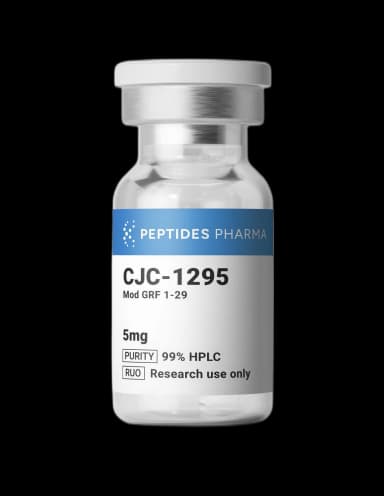
CJC-1295 (without DAC), also known as Modified GRF(1-29), has amino acid substitutions at positions 2, 8, 15, and 27 that resist DPP-IV enzymatic degradation, extending the half-life to approximately 30 minutes. It produces a slightly prolonged GH pulse compared to Sermorelin.
CJC-1295 with DAC (Drug Affinity Complex) has an albumin-binding moiety that extends its half-life to 6-8 days, producing sustained GHRH-R activation. This creates a less physiological pattern — continuous GH elevation rather than pulsatile release — but provides convenience by requiring only weekly injection.
For researchers prioritising physiological GH pulsatility and natural feedback preservation, Sermorelin is the gold standard. For researchers seeking maximal GH stimulation or convenience, CJC-1295 variants may be preferred. Combining Sermorelin or CJC-1295 with a GH secretagogue (ipamorelin or GHRP-6) produces synergistic GH release through complementary receptor mechanisms.
Peptides Pharma offers Sermorelin, CJC-1295, ipamorelin, and GHRP-6 as research-grade lyophilized vials — all manufactured to >99% purity for GH-axis research protocols.
Research Protocols and Clinical Applications
Published Sermorelin research protocols employ subcutaneous injection, typically administered before bedtime to coincide with the natural nocturnal GH secretory surge. The bedtime dosing strategy amplifies the largest physiological GH pulse of the day.
Dosing in clinical studies has ranged from 100-500 mcg per injection, with most protocols using 200-300 mcg administered once daily at bedtime. Some protocols use twice-daily dosing (morning and evening) for greater GH axis stimulation, though the bedtime dose is considered the most important.
For diagnostic GH stimulation testing, a single intravenous dose of 1 mcg/kg is administered, with serial GH measurements over 60-90 minutes. A peak GH response above a defined threshold (typically 5-10 ng/mL) indicates adequate pituitary GH reserve.
Research protocol duration varies by objective. Short-term GH-axis characterisation studies may last 2-4 weeks. Body composition and aging research protocols typically extend to 12-26 weeks, as meaningful changes in lean mass and fat distribution require sustained GH axis stimulation. IGF-1 responses are typically measurable within 2-4 weeks of initiating a Sermorelin protocol.
Sermorelin pairs naturally with GH secretagogues for synergistic protocols. The GHRH-R (Sermorelin) and GHS-R1a (ipamorelin or GHRP-6) pathways produce additive GH release when stimulated simultaneously. Buy Sermorelin UK and worldwide from Peptides Pharma with cold-chain delivery and full COA documentation.