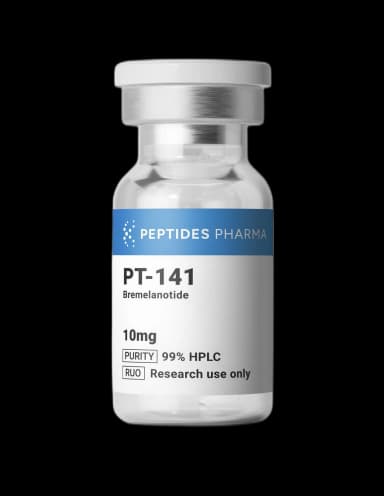
PT-141 (Bremelanotide) is a melanocortin receptor agonist that acts through central MC4R activation to modulate sexual arousal, representing the first FDA-approved CNS-mediated treatment for sexual dysfunction.
10 min read · Updated 2026-04-03
What Is PT-141 (Bremelanotide)?
PT-141, known by its generic name Bremelanotide and marketed as Vyleesi, is a synthetic cyclic heptapeptide melanocortin receptor agonist with the sequence Ac-Nle-cyclo[Asp-His-D-Phe-Arg-Trp-Lys]-OH. It is a metabolite of Melanotan II (MT-II), differing from the parent compound by the loss of the C-terminal amide group — a seemingly minor structural change that significantly alters receptor selectivity.
Developed by Palatin Technologies, PT-141 received FDA approval in 2019 as Vyleesi for the treatment of hypoactive sexual desire disorder (HSDD) in premenopausal women. This approval was historic: PT-141 is the first and only medication to treat sexual dysfunction through central nervous system melanocortin receptor activation, representing a completely novel mechanism distinct from peripheral vasodilators like sildenafil.
PT-141's mechanism centres on MC4R (melanocortin 4 receptor) activation in the hypothalamus and limbic system. MC4R is expressed in brain regions critical for sexual arousal, reward processing, and autonomic regulation. By activating these central circuits, PT-141 enhances sexual desire and arousal through top-down neural signalling rather than peripheral haemodynamic effects.
The development pathway from MT-II to PT-141 illustrates how understanding melanocortin receptor pharmacology can yield clinically useful compounds. While MT-II's non-selective receptor profile produced unwanted pigmentation alongside sexual function effects, PT-141's altered selectivity provided a cleaner pharmacological profile suitable for clinical use.
MC4R Activation: The Central Arousal Mechanism
PT-141's mechanism of action is fundamentally different from all other sexual function compounds. PDE5 inhibitors (sildenafil, tadalafil) enhance peripheral blood flow by increasing nitric oxide/cGMP signalling in erectile tissue. PT-141 acts centrally, modulating the neural circuits that generate sexual desire and arousal.
MC4R is densely expressed in the paraventricular nucleus (PVN) and medial preoptic area (MPOA) of the hypothalamus — regions that integrate hormonal, sensory, and cognitive inputs to generate sexual motivation. MC4R activation in these nuclei triggers descending neural pathways through the brainstem and spinal cord that promote genital arousal responses.
Research indicates that MC4R signalling in the PVN activates oxytocinergic neurons, and oxytocin release plays a mediating role in PT-141's pro-erectile effects. Additionally, MC4R activation modulates dopaminergic signalling in the mesolimbic reward circuit, which may contribute to the enhanced desire and motivation component of the sexual response.
Importantly, PT-141 acts on the desire/arousal phase of the sexual response cycle, not merely the mechanical genital response. This distinction is critical because HSDD — the primary indication for Vyleesi — is characterised by absent or reduced sexual desire, not physical arousal difficulties. Traditional vasodilators do not address desire-phase dysfunction, which is why PT-141 filled an unmet clinical need.
The central mechanism also explains PT-141's efficacy in both men and women. While PDE5 inhibitors are primarily effective in male erectile dysfunction (a peripheral haemodynamic issue), PT-141's central action on shared neural circuits provides a mechanism applicable to both sexes.
RECOMMENDED PRODUCT
Clinical Trials and FDA Approval
PT-141's clinical development programme included multiple Phase 2 and Phase 3 trials in both men and women, generating a robust safety and efficacy dataset.
RECONNECT Trials (Phase 3, Women): The pivotal RECONNECT studies enrolled over 1,200 premenopausal women with HSDD. PT-141 (1.75 mg subcutaneous, as needed) significantly increased the number of satisfying sexual events and scores on the Female Sexual Function Index desire domain, while reducing distress associated with low sexual desire. These results supported FDA approval in June 2019.
Male Erectile Dysfunction Trials (Phase 2): In men with erectile dysfunction, including those unresponsive to sildenafil, intranasal PT-141 demonstrated pro-erectile activity. The mechanism of action — central MC4R activation rather than peripheral vasodilation — explains efficacy in PDE5 inhibitor non-responders, whose dysfunction may have a central rather than peripheral origin.
Safety Profile: The most common adverse events in clinical trials were nausea (40%), flushing (20%), and headache (11%). Nausea was typically transient, resolving within 2 hours. A transient increase in blood pressure was observed in some subjects, leading to a labelling precaution for patients with uncontrolled hypertension or cardiovascular disease.
The FDA restricted Vyleesi prescribing to no more than once every 24 hours and no more than 8 doses per month, based on the clinical trial dosing protocols. Research applications are not subject to these prescribing restrictions, and varied dosing schedules have been employed in preclinical and investigator-initiated studies.
PT-141 Molecular Profile
- Full Name: PT-141 / Bremelanotide / Vyleesi - Sequence: Ac-Nle-cyclo[Asp-His-D-Phe-Arg-Trp-Lys]-OH - Molecular Formula: C₅₀H₆₈N₁₄O₁₀ - Molecular Weight: 1,025.17 g/mol - Classification: Synthetic cyclic heptapeptide melanocortin agonist - Primary Receptor: MC4R (melanocortin 4 receptor) - Secondary Receptors: MC1R, MC3R (lower affinity than MT-II) - Half-life: Approximately 2.7 hours - FDA Status: Approved (Vyleesi) for HSDD in premenopausal women
PT-141 differs from Melanotan II by a single structural modification: the C-terminal amide (-NH2) of MT-II is replaced by a free acid (-OH) in PT-141. This change reduces MC1R binding affinity (less pigmentation) while maintaining MC4R activity (sexual function), providing a more selective pharmacological profile.
Peptides Pharma PT-141 is manufactured in GMP-certified facilities with >99% HPLC purity. Each vial includes full Certificate of Analysis with HPLC chromatogram and mass spectrometry data confirming molecular identity.
RECOMMENDED PRODUCT
PT-141 vs Other Sexual Function Compounds
The sexual function research landscape includes multiple compound classes with fundamentally different mechanisms. Understanding these distinctions is essential for protocol design.
PT-141 vs PDE5 Inhibitors (Sildenafil/Tadalafil): PDE5 inhibitors enhance nitric oxide/cGMP signalling in penile erectile tissue, promoting vasodilation and erection. They do not affect desire or central arousal. PT-141 acts centrally on MC4R to enhance desire and arousal through neural signalling. These mechanisms are completely non-overlapping and potentially synergistic.
PT-141 vs Melanotan II: MT-II and PT-141 share the cyclic peptide core but differ in receptor selectivity. MT-II activates MC1R strongly (causing pigmentation) alongside MC3R/MC4R. PT-141 has reduced MC1R activity, producing less pigmentation while retaining MC4R-mediated sexual function effects. For researchers specifically studying sexual function pathways, PT-141 provides a cleaner tool compound.
PT-141 vs Flibanserin: Flibanserin (Addyi) acts on serotonin receptors (5-HT1A agonist, 5-HT2A antagonist) and requires daily dosing. PT-141 acts on melanocortin receptors and is used on-demand. Different receptor targets mean these compounds can be studied independently or in combination for additive mechanism research.
Buy PT-141 research vials from Peptides Pharma for melanocortin receptor and sexual function research. All PT-141 UK orders include full Certificate of Analysis and worldwide cold-chain delivery.
Research Protocols and Applications
PT-141 research spans multiple domains beyond sexual function, reflecting the diverse roles of melanocortin signalling in physiology.
For sexual function research, protocols typically use single doses of 0.5-2 mg administered subcutaneously, with assessments conducted 1-6 hours post-injection. Both subjective (arousal questionnaires, desire inventories) and objective (genital photoplethysmography, penile rigidity monitoring) endpoints are used depending on the research question.
Melanocortin receptor pharmacology research uses PT-141 alongside MT-II and selective MC receptor agonists/antagonists to characterise receptor-mediated signalling in various tissues. The comparison between PT-141 (reduced MC1R, retained MC4R) and MT-II (broad MC activity) is particularly informative for understanding receptor selectivity-activity relationships.
Emerging research areas for PT-141 include haemorrhagic shock (MC4R activation has shown haemodynamic rescue effects in preclinical models), appetite regulation (MC4R is a key anorexigenic target), and pain modulation (melanocortin receptors modulate nociceptive processing). These applications leverage the same MC4R mechanism studied in sexual function research but in different physiological contexts.
Peptides Pharma offers PT-141 vials alongside Melanotan II for comprehensive melanocortin research. Both compounds are manufactured to >99% purity in GMP-certified facilities with full COA documentation. Worldwide delivery with cold-chain packaging ensures peptide integrity for research applications.