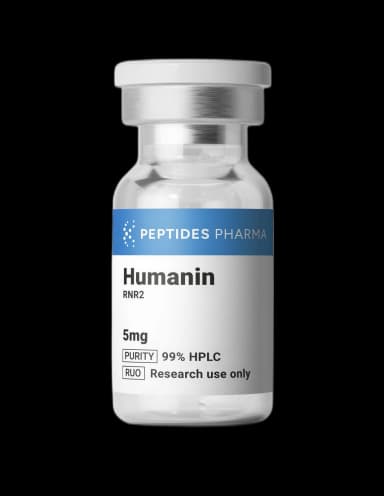
What is Humanin?
Humanin (RNR2 Mitochondrial-Derived Peptide (Humanin)) is classified as a mitochondrial-derived peptide (mdp). With a molecular weight of ~2687 Da and formula C121H206N34O33S2, it is one of the most studied compounds in its class.
This encyclopedia entry covers the molecular profile, mechanism of action, research history, key published studies, and research applications of Humanin. It is part of the Peptides Pharma Peptide Encyclopedia, a scientific reference for researchers working with peptide compounds.
Molecular Profile
MOLECULAR FORMULA
C121H206N34O33S2
MOLECULAR WEIGHT
~2687 Da
CLASSIFICATION
Mitochondrial-Derived Peptide (MDP)
AMINO ACID SEQUENCE / STRUCTURE
Met-Ala-Pro-Arg-Gly-Phe-Ser-Cys-Leu-Leu-Leu-Leu-Thr-Ser-Glu-Ile-Asp-Leu-Pro-Val-Lys-Arg-Arg-Ala (MAPRGFSCLLLLTSEIDLPVKRRA)
Mechanism of Action
Humanin is a 24-amino acid peptide encoded by the MT-RNR2 gene within the mitochondrial 16S ribosomal RNA region, making it one of the first identified mitochondrial-derived peptides (MDPs). Research suggests that humanin exerts its cytoprotective effects primarily through binding to two distinct receptor complexes. It interacts with the trimeric receptor composed of CNTFR (ciliary neurotrophic factor receptor), WSX-1, and gp130, activating downstream JAK2/STAT3 signalling cascades that promote cell survival and suppress apoptosis.
Humanin also binds to and neutralises IGFBP-3 (insulin-like growth factor binding protein-3) and BAX, a pro-apoptotic member of the Bcl-2 family. By sequestering BAX, humanin prevents its translocation to the mitochondrial outer membrane, thereby blocking the intrinsic apoptotic pathway — specifically the release of cytochrome c and subsequent caspase activation. This anti-apoptotic mechanism is particularly relevant in neurodegenerative contexts, where mitochondrial dysfunction and excessive neuronal apoptosis are central pathological features.
Additionally, studies indicate that humanin modulates cellular metabolism by improving mitochondrial function, reducing reactive oxygen species (ROS) production, and enhancing insulin sensitivity. Circulating humanin levels have been shown to decline with age in both animal models and human cohorts, leading to its investigation as a biomarker and potential therapeutic target in age-related diseases including Alzheimer's disease, type 2 diabetes, and cardiovascular pathology.
Research History
Humanin was discovered in 2001 by Nishimoto and colleagues during a functional expression screen of a cDNA library derived from the occipital cortex of an Alzheimer's disease patient. The researchers identified a short open reading frame within the mitochondrial genome that encoded a peptide capable of protecting neurons from amyloid-beta toxicity — a hallmark of Alzheimer's pathology. This discovery was groundbreaking because it demonstrated that the mitochondrial genome, previously thought to encode only 13 structural proteins, could produce bioactive peptides with signalling functions.
Subsequent research throughout the 2000s and 2010s revealed that humanin is part of a broader family of mitochondrial-derived peptides, including MOTS-c and SHLPs (Small Humanin-Like Peptides). Studies expanded beyond neuroprotection to demonstrate humanin's roles in metabolic regulation, cardiovascular protection, and cellular stress responses. Synthetic analogues such as HNG (S14G-humanin) were developed with enhanced potency — up to 1000-fold greater than native humanin — enabling more detailed mechanistic studies. Research has also established that circulating humanin levels correlate inversely with age and age-related disease burden, positioning it as both a potential biomarker of mitochondrial health and a research candidate for age-related conditions.
Key Published Studies
Humanin, a peptide encoded in the mitochondrial genome, rescues neuronal death caused by Alzheimer's disease-related insults
2001
First identification of humanin as a mitochondrial-derived peptide that protects neurons against amyloid-beta, presenilin, and APP-induced cytotoxicity in cell culture models.
Humanin and age-related diseases: a new link between mitochondrial signalling and human longevity
2009
Demonstrated that circulating humanin levels decline with age in humans and correlate inversely with IGF-1 levels, suggesting a role in the ageing process.
S14G-humanin (HNG) improves cognition and reduces amyloid pathology in Alzheimer's mouse models
2012
The synthetic analogue HNG, 1000-fold more potent than native humanin, reduced amyloid-beta plaque burden and improved spatial memory in transgenic AD mice.
Humanin improves insulin sensitivity and reduces hepatic glucose production
2014
Research indicated that humanin administration improves glucose tolerance and insulin sensitivity in high-fat-diet mice, acting through hypothalamic STAT3 signalling.
Mitochondrial-derived peptides as novel regulators of metabolism and ageing
2018
Comprehensive review establishing humanin as a founding member of the MDP family, with documented roles in cytoprotection, metabolic regulation, and stress response across multiple organ systems.
Research Applications
Neuroprotection and Alzheimer's disease research
Mitochondrial-derived peptide biology
Anti-apoptotic signalling pathway studies
Age-related disease and longevity research
Insulin sensitivity and metabolic regulation
Cardiovascular protection studies
Oxidative stress and ROS reduction research
Biomarker development for mitochondrial health
RECOMMENDED PRODUCT